Two Misleading claims by Answers in Genesis
by Philobytes - November 22nd, 2017.Filed under: Uncategorized.
I get asked why I no longer believe the claims made by young earth creation (YEC) sites like icr.com (ICR_, answersingenesis.com (AIG), or creation.com (CREATION) all the time in online forums. So rather than post the same information repeatedly, I’ve decided to make a simple blog post illustrating how they lie to believers.
The two examples I’m listing are only an indicator of the pattern of behaviors exhibited by the folks at these YEC sites. The first is example is very basic and simple error. It’s easy for the people at YEC sites to fix and correct and yet they haven’t after having it pointed out to them. That indicates that they really don’t care about truth. It’s simply a chart used on several articles in both ICR and AIG . It was used in articles by both Andrew Snelling and Steve Austin. The chart is question is:
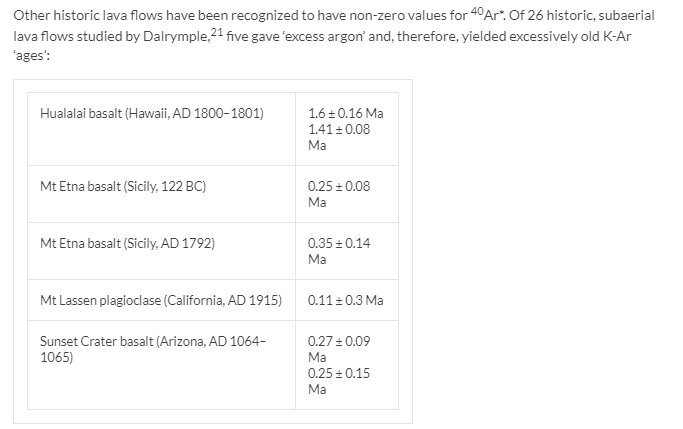
This charts is posted in AIG and ICR from the following sources:
https://answersingenesis.org/geology/mount-st-helens/argon-in-mineral-concentrates-from-mount-st-helens-volcano/
https://answersingenesis.org/geology/radiometric-dating/anomalous-potassium-argon-ages-implications/
http://www.icr.org/article/argon-mount-st-helens/
https://creation.com/excess-argon-within-mineral-concentrates
The chart in question is taken from data collected by Darlymple (1969) and looks like this:
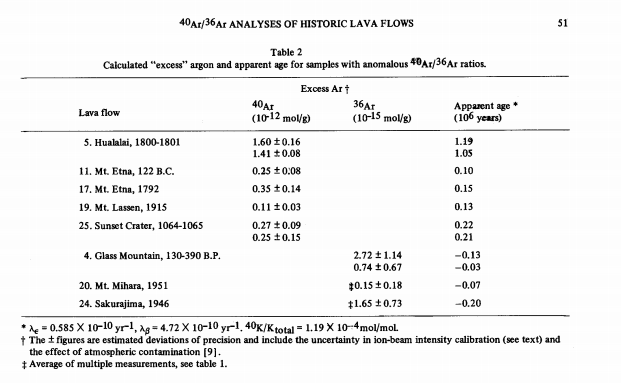
Take note of the actual numbers in the second chart and compare them to the first. To make it easier here is a combination:
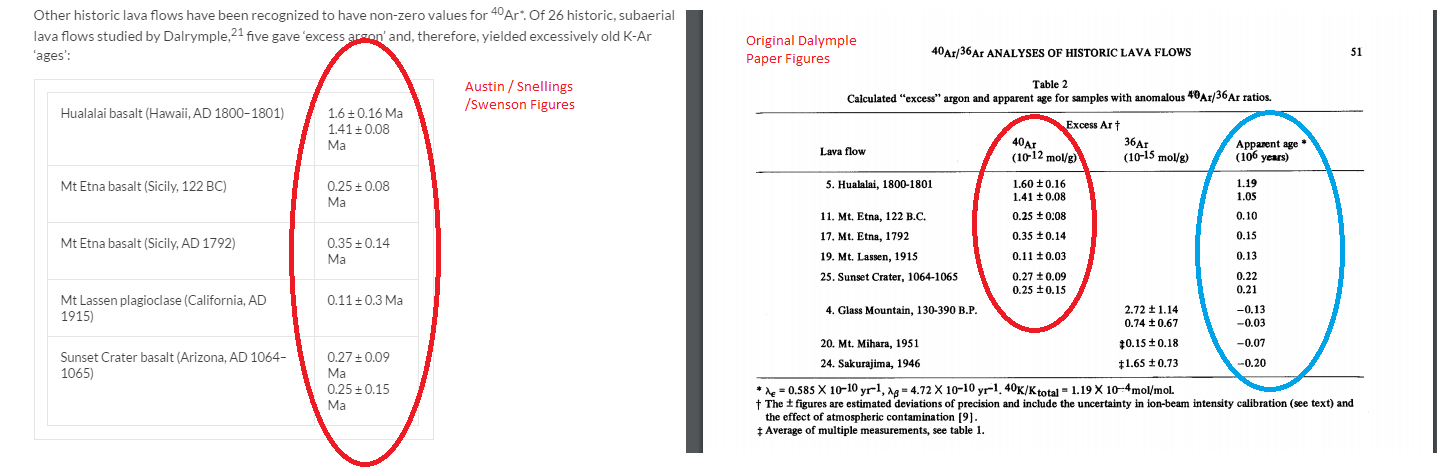
In this example, Austin and Snellings both made an error and listed the wrong data as dates. They listed instead the sample Ar36/40 amounts. This mistake is perpetuated by other creationists and sites and has not been corrected by Snellings and Austin. Now it could be a simple mistake, but if that’s the case, why haven’t any of these sites issued a retraction? why is that information still being promoted through other creationists? These errors and a further error (or deliberate falsehood) made by Austin and Snelling are outlined by other scientists who outline the mistakes and errors better than I can. Especially since they have the knowledge and certifications in the field.
Error #2
The second error is more complicated and is actually the one that led me to start my questioning. It was during the 2012 Ken Ham / Bill Nye debate. From the site, here’s a transcript of the debate portion in full:
“Let me introduce you to another scientist, Richard Lensky, at Michigan State University. He is a great scientist; he is known for culturing E. coli in the lab, and he found, there were some E. coli that seem to develop the ability to grow on a substrate, on citrate as a substrate. Lensky is mentioned in this book “Evolution in the Lab.” So the ability to grow on citrate is said to be evolution, and there are those who say, “Hey, this is against the creationists.†For instance, Jerry Coyne, an evolutionary biologist at the University of Chicago says, “Lensky’s experiment is also yet another poke in the eye for anti- evolutionists.” He says, “The thing I like most is, it says you can get these complex traits evolving by a combination of unlikely events.†He says, “That’s just what creationists say can’t happen.” But is it a poke in the eye for anti-evolutionists? Is it really seeing complex traits evolving? What does it mean that some of these bacteria are able grow on citrate? Let me introduce you to another biblical creationist who is a scientist, Andrew Fabbich.”
“Video clip: “My name is Andrew Fabbich, and I got my PhD at the University of Oklahoma in microbiology. I teach at ?Liberty? University, and I do research on E. coli in the intestine. I have published in secular journals, from the American Society for Microbiology, including infection and immunity, The American Society for Immunology, as well as several others, and my work has been cited last year in the journals Nature, etc., etc. While I was taught nothing but evolution, I don’t accept that position. I do my research from a creation perspective. When I look at the evidence that people cite as the E. coli supposedly evolving, over 30 years, over 30,000 generations in the lab, people say that it is now able to grow on citrate. I don’t deny that it grows on citrate, but it’s not any kind of new information. The information is already there, it’s just a switch that gets turned on and off. That’s what they reported, and there is nothing new.”
Ham and Andrew Fabich both made the point that the experiment by Blount et al was an example of “gene switching on and off”. Blount himself gives an excellent treatment of the issues and blatant errors made by both Ham and Fabich. Quite simply, it was not simply a gene switching on, but rather a duplication of genes to create a new function. As Blount explains:
“You see, one of the major aspects of gene regulation is that genes have associated regulatory DNA sequences, including what are called promoters that control when genes are expressed. The citT gene is normally controlled by a promoter that tells the cell to turn it on only when there is no oxygen present. As shown in the Figure below, the gene duplication put one copy of citT next to, and under the control of, a promoter that normally controls another gene called rnk. The rnk gene is normally turned on when oxygen is present. The new association between citT and the rnkpromoter – what we call the rnk-citT regulatory module – turns citT on when oxygen is present, and allows Cit+ cells to use citrate under the conditions of the LTEE.”
You can check out both Blount’s paper and his dissertation speech and see for yourself whether or not Ham was telling the truth. As for the claim of “new information, I’m still awaiting for a good definition of information and how we would know if “new information” happened. Until then, their argument is lacking.
Summary
In summing up, I hope it is clear that at least in these two cases, it’s clear that YEC sources have a habit of lying to their constituents and in some cases are deliberate in order to prop up their side. If they have the truth, then why lie?