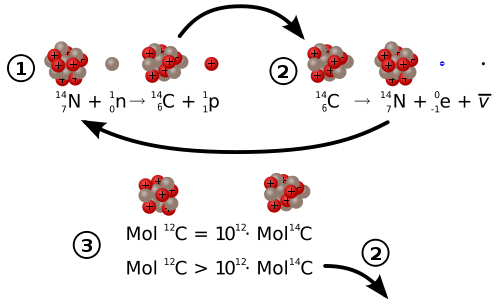
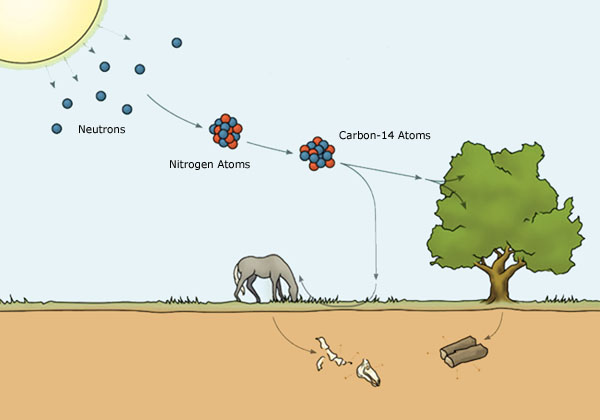
When I started my first post, which you can read below, I had sated that I didn’t find much online literature that put all the pieces together in a detailed manner. If I had seen this article by Woolf1, I might have just posted a link and made some commentary. Woolf explains very eloquently the methods and fundamentals of Carbon14 among other radiometric dating methods in a fairly detailed fashion. Having said that, I still think I can build from his article and provide a full framework of the carbon-14 method and therefore intend to write the remaining posts and add in a couple posts discussing claims by creationists – and again this is just a way to generalize a person who believes and argues for young earth creation, the same as a uniformitarianists is a person who argues for an old earth as currently understood by mainstream science; any negative/positive connotations to the words are in the minds of the reader alone.
Woolf sums up the contents of my original post in a succinct and detailed manner:
The element carbon occurs naturally in three nuclides: C12, C13, and C14. The vast majority of carbon atoms, about 98.89%, are C12. About one atom in 800 billion is C14. The remainder are C13. Of the three, C12 and C13 are stable. C14 is radioactive, with a half-life of 5730 years. C14 is also formed continuously from N14 (nitrogen-14) in the upper reaches of the atmosphere. And since carbon is an essential element in living organisms, C14 appears in all terrestrial (landbound) living organisms in the same proportions it appears in the atmosphere.
Plants and protists get C14 from the environment. Animals and fungi get C14 from the plant or animal tissue they eat for food. When an organism dies, it stops taking in C14. The C14 already in the organism doesn’t stop decaying, so as time goes on there is less and less C14 left in the organism’s remains. If we measure how much C14 there currently is, we can tell how much there was when the organism died, and therefore how much has decayed. When we know how much has decayed, we know how old the sample is. Many archaeological sites have been dated by applying radiocarbon dating to samples of bone, wood, or cloth found there.
Radiocarbon dating depends on several assumptions. One is that the thing being dated is organic in origin. Radiocarbon dating does not work on anything inorganic, like rocks or fossils. Only things that once were alive and now are dead: bones, teeth, flesh, leaves, etc. The second assumption is that the organism in question got its carbon from the atmosphere. A third is that the thing has remained closed to C14 since the organism from which it was created died. The fourth one is that we know what the concentration of atmospheric C14 was when the organism lived and died.
That last one is more important than it sounds. When Professor William Libby developed the C14 dating system in 1949, he assumed that the amount of C14 in the atmosphere was a constant. However, after a few years a number of scientists got suspicious of this assumption, because dates obtained by the C14 method weren’t tallying with dates obtained by other means. A long series of studies of C14 content produced an equally long series of corrective factors that must be taken into account when using C14 dating. So the dates derived from C14 decay had to be revised. One reference on radiometric dating lists an entire array of corrective factors for the change in atmospheric C14 over time. C14 dating serves as both an illustration of how useful radiometric dating can be, and of the pitfalls that can be found in untested assumptions.
There are three areas which stem from this which can shed light further on the accuracy of carbon14 dating. These include the history of carbon14 (in brief), the formulas for determining how much carbon14 is in a sample and how old it is, as well as the methods of calibration.
Brief History of Carbon dating
William Libby in a paper outlining the history of radiocarbon dating2, explains how in the early 1930s several scientists at the time discovered the effects of cosmic rays on our nitrogen atmosphere (causing neutrons) and conducted some experiments which, as noted by Libby, led to the discovery of Carbon-143.
Three important facts present themselves from a reading of these articles. The first is an overall improvement of techniques and methods and corrections over the time. This is because, science’s goal is to find a system of knowledge for understanding the universe around us. Old theories are revamped, updated, improved, or replaced by new information, data, and repeatable experiments leading to new theories. Once established though, the more evidence is required for modification. This is true of everything from the theory of gravity to the law of superposition.
Second, while not ideal, sometimes assumptions must be made in science. These assumptions should be small, limited in scope, in order to prevent large sources of error. For instance, if conducting heat/cold experiments with mice, limited assumptions about behavior (the mouse prefers a certain temperature over others) are valid. These draw from our experiences as well as natural occurrences. I would be invalid to suggest the mouse avoids colder temps because he hears voices in his head. Based on this Libby made some limited presumptions and during his experiments tested them. One was the mixing of ocean water carbon-14 content compared to atmosphere; another the fact that the carbon-14 he was dating had been mixing with the atmosphere for the last 30,000 years and was at equilibrium. These were based on some evidences and seemed to fit the data observed in their experiments well. Some of these – such as the mixing rates of carbon in ocean waters – were verified, adjusted as necessary, and still studied today. Others like the rates of equilibrium were modified later based on new data.
However, a third fact is that some untestable presuppositions can and do influence scientists in some ways in their experiments and theories. For instance, the underlying theory of naturalism, that the universe operates in predictable, naturalistic patterns, means that supernatural means are the least likely explanation, if at all, for observed phenomena. As far as non-miraculous events (i.e the resurrection of Jesus) I would tend to agree. However, these presuppositions (worldview) can also lead to dismissing things that either don’t fit, or are presumed to not work. For instance, Libby speaks about finding methods to test living matter with radiocarbon dating and immediately rules out methane from an oil well “since it would be too old”2. This epitomizes the claims of creationists. A final note is how disconnected they were from the studies outside their field – Libby and Arnold were surprised that the only reliably dated artifacts were actually (at the time) only 5,000 years old. Indeed famously, Libby states:
The first shock Dr. Arnold and I had was when our advisors in- formed us that history extended back only to 5,000 years. We had thought initially that we would be able to get samples all along the curve back to 30,000 years, put the points in, and then our work would be finished. You read statements in books that such and such a society or archeological site is 20,000 years old. We learned rather abruptly that these numbers, these ancient ages, are not known accurately; in fact, it is at about the time of the First Dynasty in Egypt that the first historical date of any real certainty has been established.
The same claims are made today how the literature “hides” the true information about the vulnerability of uniformitarianism. Unfortunately, the reverse is also true for the both sides, ideas that have been dismissed or abandoned frequently crop up in the literature.
Calibration
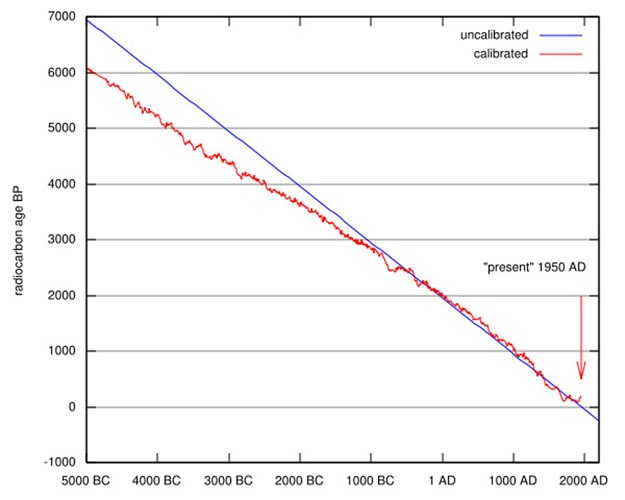
In the 1950s was later noted that some radiocarbon dates did not align with known Egyptian artifacts.4. They were measured to be too young, not older. Libby himself spoke about the possibility of cosmic ray variance, but their studies had not indicated any changes. Later,it was discovered that carbon-14 creation does vary slightly and correlates to the strength and direction of the earth’s magnetic field which affects cosmic rays. Several methods were presented as calibration curves to make the process more accurate. These methods included tree-ring chronology (dendrochronology), ice cores, varves, and other dated materials. The specifics of these methods will be outlined in other topics. Below is a graph of calibration methods. The currently favored one is the IntCal09 as reported by Reimer and others. A Sample of these curves are seen here:
http://c14.arch.ox.ac.uk/embed.php?File=typical_cal.html
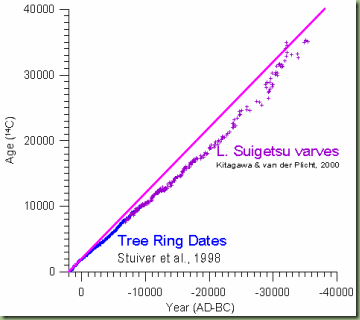
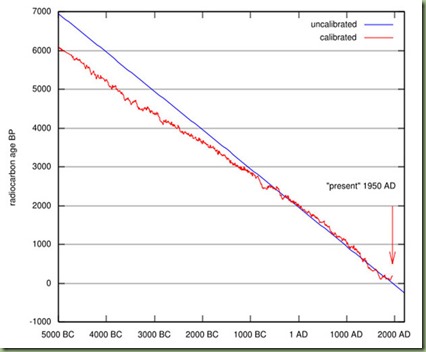
A closer look at the last 5,000yrs calibrated by tree rings is shown below. It is clear when one looks at the graph that less there is less that 1,000yrs difference between uncalibrated carbon-14 ages and the tree ring data. Furthermore, looking at the chart above , the ratio of years difference decreases after a certain period of time. Using these calibration methods, one can arrive at what is thought to be a more accurate date. These calibrations are arrived using objects with known dates, using other dating methods or historical evidence.
Radiometric Decay Rates
Radiometric decay rates, including carbon-14, are stated to conform to predictable and stable decay rates. From these we can use a series of formulas to calculate how much parent material was present (assuming this wasn’t changed in the past), what the half-life of the isotope is, what the constant decay rate is (assuming the rate stayed constant throughout the life of the isotope), and how old the object is (assuming it falls within the range datable by the isotope). These calculations, admittedly, all rely on assumptions, but if correct can be used to date objects. One thing to point out again is that due to the decay rates amounts of isotopes, they are limited to specific ranges. Carbon-14 is theorized to date only to 100,000yrs old.
Note: the following sites explain these equations very well and are useful to look at:
http://www.chem.purdue.edu/gchelp/howtosolveit/Nuclear/Half_Life.htm#carbondating
http://chemistry.about.com/od/workedchemistryproblems/a/ratedecay.htm
http://science.howstuffworks.com/environmental/earth/geology/carbon-142.htm
Also, this site has an excellent excel table for calculating several properties of decay – look for the Exploring Radioactive Decay handout:
http://academic.pgcc.edu/~ssinex/excelets/chem_excelets.htm
the basic formula for most operations is shown below:
tage = [ ln(N/No) / –k ] * t1/2
Where Ln is the natural logarithm,
N/No is the ratio of 14C to 12C. This can be expressed in several ways – decay counts, grams, moles, percent, etc – as long as they’re the same units. k is the decay constant rate, and tage is the time elapsed from the time of death. Finally, t1/2 would be the half-life of the element.
For example if we had a sample of wood with an activity of 7.0 counts per minute (decays per minute – cpm) and a similar sample of freshly cut wood of the same type of tree had an activity of 15.3 cpm and we wanted to know how old the tomb sample is. Now to determine an age is easy if you know two things, the half-life of the isotope, and the rate constant. For instance,
t = [ln(7/15.3) / (-.693)] *(5730)
t = (1.1283) * 5730
t = 6465
It should be noted that this assumes an equilibrium of carbon-14 creation which we know is not true and therefore this should be calibrated to a standard. Second, while the half-life in known today as 5730yrs Libby calculated it as 5568yrs. It is customary to calculate using this number then adjust using the calculation curves.
Further Considerations
Dating “is not like dusting crops”, some complexities exist in how much carbon is absorbed by the living creature or plant. These include the difference of C3 to C4 plants and the carbon life cycle of marine animals as well as human effects like the industrial revolution and nuclear age. However, all of these complexities can be accounted for using techniques to determine the true age. For instance, the differences of the plants can be calculated by the ratio of carbon-12 to carbon-13, which is measured in the laboratories, as it is affected the same way as carbon-14 in the process of fractionalization within photosynthesis. The effects of nuclear decay are calibrated using a source to test against from before any nuclear testing was performed. The same goes for industrial revolution contamination. By studying and measuring the intake rate of the oceans, a standard can be applied.
Sources:
1. Woolf – Essay on Carbon Dating
2. Libby – History of Radiocarbon Dating
3. Libby – Nobel Lecture
4. Australian National University.